
Most parents expect swimming lessons to teach recognised strokes such as freestyle, backstroke, and breaststroke. But a child who can perform a stroke in calm, shallow water may still lack the practical skills needed if they unexpectedly enter deep water, become tired, or struggle to reach the pool edge.
This is why swimming lessons should develop more than stroke technique. Children also need opportunities to practise floating, treading water, orienting themselves, and moving towards safety. At Paul Sadler Swimland, this philosophy has shaped our approach for more than 50 years and explains why we are known as the Survival Specialists.
Swimming Technique and Survival Ability Serve Different Purposes
Stroke development and survival training each play a distinct role in a child’s swimming education. Stroke technique helps children move efficiently through the water for recreation, fitness, and competition. Survival training prepares them to respond when conditions are less predictable.
Stroke technique focuses on efficient movement, while survival practice teaches children how to pause, recover, and decide what to do next.
This is the principle behind swim and survival education. Children should not have to choose between becoming competent swimmers and developing practical water-safety skills. The two should progress together.
For parents asking why teach children survival skills, the answer is that swimming technique alone does not prepare a child for every situation they may encounter. This broader focus is what makes our approach different from a typical swim school.
The Survival Skills Children Need in the Water
Practical water-safety training can help children respond more calmly if something unexpected happens.
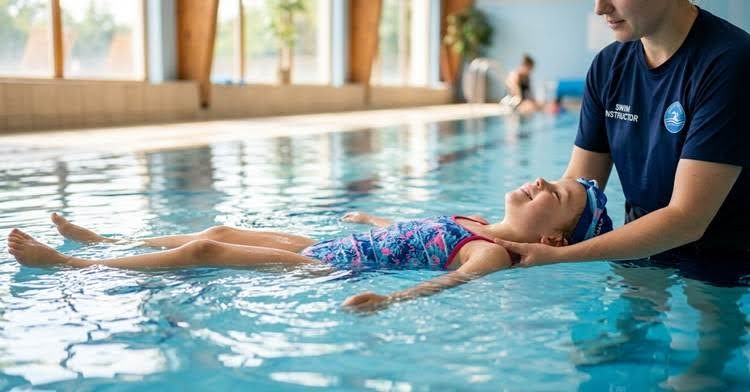
These include returning to the surface after submersion, floating on the back to rest and breathe, treading water, changing direction, locating an exit, moving towards the pool edge or shore, and entering and exiting the water safely. Children also benefit from learning to call for help and remain as calm as possible when they are out of their depth.
These skills work together rather than in isolation. Floating can give a child time to rest and breathe. Treading water can help them remain in one place while waiting for assistance, while orientation skills can help them identify where safety is located.
Building Deep Water Safety for Kids
Many children initially learn in water where they can stand comfortably. However, deep water safety for kids requires progressive, supervised experience in an environment where standing is not an option.
Without the option of standing up to rest, children need to practise supporting themselves in the water and reaching an exit under the supervision of trained teachers.
At Paul Sadler Swimland, deep-water practice is incorporated into lessons as appropriate for each child’s swimming ability and stage of development.
Survival Skills Develop at Every Stage
Survival education should develop alongside swimming ability rather than waiting until a child reaches an advanced level. Skills can be introduced appropriately from a child’s earliest experiences in the water and extended as their physical ability and confidence increase.
In fact, even babies in our Parent/Child Program build water confidence early, creating familiarity with the water that can provide a foundation for later learning. As children grow, their survival activities can become progressively more challenging.
Through our 13-level Learn to Swim program, these abilities are reinforced as children progress. A beginner may practise returning to the surface and floating, while a more capable swimmer may work on extended treading, deeper-water activities, or swimming in more challenging situations.
Regular practice helps reinforce these responses, so survival education should continue throughout the program rather than being limited to a dedicated water-safety lesson.
How Do Survival Skills Support Child Drowning Prevention?
Swimming lessons are an important layer of child drowning prevention. A 2009 study published in Archives of Pediatrics & Adolescent Medicine found that participation in formal swimming lessons was associated with an estimated 88% lower risk of drowning among children aged one to four. However, lessons cannot remove the risk entirely. No child should be considered drown-proof, regardless of how confidently they swim.
This distinction matters because children may encounter water unexpectedly or face circumstances that are different from their usual swimming lesson. Survival-focused teaching gives children additional skills for responding to these situations, while supervision and other safety measures remain essential.
Parents and caregivers should continue to provide close, attentive supervision around water and use appropriate barriers and safety equipment. A supervising adult should remain focused on the child rather than assuming swimming ability means supervision can be relaxed.
Why Should Swimming and Survival Skills Be Taught Together?
Combining stroke technique with practice in responding to unexpected situations creates a more complete swimming education. The goal is not to frighten children or suggest that every swimming experience is dangerous. It is to give them the confidence and skills to enjoy water while also knowing how to respond when circumstances change.
Regular practice also helps these responses become familiar rather than introducing them only during a dedicated safety lesson. Children can practise floating, treading, deep-water swimming, safe entry and exit, and other responses while continuing to improve their strokes.
Developing both areas gives children a foundation for enjoying the water more confidently throughout childhood.
Swimming Lessons Should Prepare Children for More Than Strokes
Swimming lessons should prepare children to move confidently through the water and respond when circumstances change. At Paul Sadler Swimland, survival education is integrated into swimming development rather than treated as a separate topic. The aim is to help children become capable swimmers who also have practical skills for responding when conditions are not as expected.
Parents who would like more information about lessons, programs, and water-safety teaching can find answers in our FAQs.
Contact your nearest Paul Sadler Swimland location to discuss a suitable starting level for your child.
FAQs
At what age should survival skills be introduced?
Age-appropriate activities can begin from a child’s earliest swimming experiences. Water familiarity and confidence can begin early, while more advanced skills are introduced as children develop physically and cognitively. Parents unsure about timing can read more about knowing when your child should start lessons.
Can survival swimming lessons make my child drown-proof?
No. No swimming program can make a child drown-proof. Lessons provide an important layer of protection, but close adult supervision and appropriate water-safety measures remain essential.
What is the difference between survival skills and stroke technique?
Stroke technique teaches children to move through the water efficiently. Survival training focuses on practical responses such as floating, treading water, recovering after an unexpected entry, orienting towards safety, and managing deeper water.
Why is deep-water practice important?
Deep-water practice allows children to apply what they have been taught without relying on being able to stand. Progressive, supervised exposure can help build confidence and reinforce floating, treading, breathing, and movement skills.
Should children continue practising survival skills as they get older?
Yes. Activities should progress as a child’s strength, swimming ability, and experience increase. Continued practice helps reinforce existing responses while introducing more challenging activities appropriate to their stage of development.