
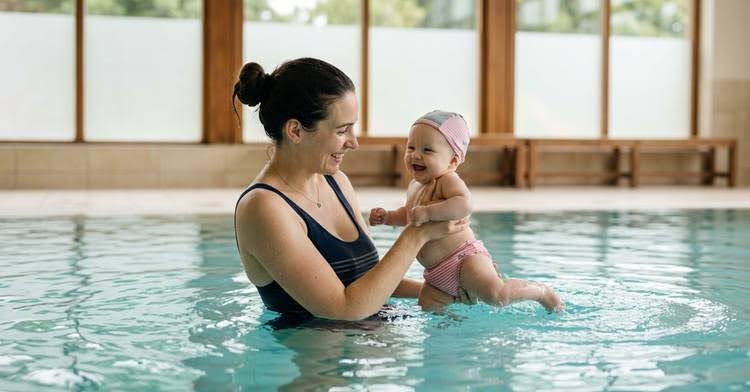
If you are a new parent, you might be wondering if four months is too soon to think about swimming lessons. It is a common question. Baby swimming lessons at this age provide gentle, fun water experiences shared between you and your child, helping to build a foundation that can support future swimming development.
We designed our Parent/Child Program for babies aged 4 months to 3 years around this principle. With a parent or carer in the water at every step, babies are introduced to the aquatic environment through songs, supported movement, and age-appropriate activities that build water confidence, encourage bonding, support early movement and social interaction, and the beginnings of water-safety skills.
Paul Sadler Swimland has been helping families build water confidence and survival skills for over 50 years. Our approach to swimming lessons is baby led and uses gentle, age-appropriate activities that respect each child’s individual pace of development.
When Can Baby Swimming Lessons Begin?
Many parents ask when to start baby swimming lessons, and for good reason. Four months can feel early, especially for first-time parents. At this stage, lessons are designed around parent-assisted activities allowing babies to become gradually accustomed to being in the water and focussed on recovery techniques if they were to fall in unexpectedly.
Swimming lessons for 4 month olds look very different from lessons for older children. At this age they are not physiologically ready to perform swimming strokes. Instead, sessions use a gentle baby led approach and focus on cuing and submersion readiness. There is a big focus on water activities that relax and calm both baby and carer as this promotes comfortable swimmers and enables learning to be achieved.
Every baby develops differently, so parents should consider their child’s individual health, development, and circumstances when deciding when to begin. If you are unsure about timing, you can read more about the right age to start (and when to stop) lessons.
Developing Comfort and Confidence in Water
Water confidence develops gradually through consistent, supportive experiences. When babies are safely held in different positions, gently introduced to submersion on their own initiation, and guided through simple activities, they can begin becoming familiar with how water feels and how their bodies move in it.
Our qualified instructors guide parents through each activity, demonstrating how to hold, support, and move with their baby. This helps parents and babies become more comfortable with the aquatic environment without rushing the process.
Early positive experiences can make water a familiar part of a child’s routine. However, confidence should never be treated as guaranteed simply because lessons begin early. Each child responds differently, and the focus should remain on creating supportive experiences that allow confidence to develop naturally.
This gradual introduction is one of the important benefits of baby swimming. Instead of waiting until a child is older to introduce the pool environment, families can begin creating positive associations with water from infancy.
Supporting Movement, Interaction, and Bonding
The benefits of infant swimming can extend beyond becoming comfortable in the pool. Parent-child bonding is one of the most meaningful parts of early lessons because classes provide dedicated time for parents and babies to interact through movement, touch, eye contact, songs, and shared activities without external distractions.
Water also provides buoyancy, allowing babies to experience movement differently from how they do on land. With a parent supporting them, babies can experience different positions and ranges of movement that encourage body awareness and coordination.
The pool also introduces new sights, sounds, movements, and sensations. Group classes add another dimension by giving babies opportunities to experience an environment with other children and parents.
These developmental benefits should not be overstated. Griffith University’s Early-Years Swimming study found that swimming children aged three to five performed ahead of population norms on several physical, cognitive, and language measures. However, these findings do not establish the same benefits for infants or prove that swimming alone caused the differences. For babies, the primary goal remains a positive, age-appropriate introduction to swimming and the aquatic environment.
Introducing Survival and Water-Safety Skills Early
Infant swim lessons can also introduce simple, age-appropriate water-safety concepts while a parent or carer remains directly involved. Depending on a baby’s development and progress, activities can include basic breath-control cues, supported movement, water familiarisation, and unassisted movement towards a parent or pool edge.
All of our swim programs focus on swimming, survival, and water safety skills in an engaging, entertaining, and educated way.
At Paul Sadler Swimland, we believe in building survival skills from the very first lesson. For babies, this does not mean expecting them to independently manage a water emergency. Instead, it means beginning an age-appropriate progression that can develop as their physical abilities and swimming skills grow.
It is important to distinguish early water-safety education from drowning prevention guarantees. Baby swimming lessons cannot make an infant drown-proof and never replace close adult supervision, secure barriers, and appropriate safety precautions. Lessons are one part of a broader approach to helping families build safer habits around water.
Helping Parents Become More Confident Around Water
Parent-assisted lessons are not only about the baby. They also give parents experience handling and supporting their child in the water under the guidance of a qualified instructor.
For first-time parents in particular, this can make the pool environment feel less unfamiliar. Instructors demonstrate appropriate holds, movements, and activities while parents practise participating safely with their babies. Shared water experiences can also strengthen trust as both parent and baby become more familiar with the lesson routine.
These practical experiences can make swimming a more comfortable family activity. However, lessons do not qualify parents to teach swimming independently or manage aquatic emergencies without appropriate training. The aim is to build familiarity, confidence, and positive habits while professional instructors guide the learning process.
As babies grow into young children, the nature of lessons changes too. Swim classes for toddlers can build on the familiarity established during infancy by introducing increasingly independent movement and more advanced swimming and survival activities.
Progressing Beyond the Parent/Child Program
The Parent/Child Program establishes familiarity with lessons, instructors, routines, and early water skills before children progress towards independent swimming without a parent.
Children who have participated in parent-assisted classes already know what it feels like to enter the pool, follow an instructor’s cues, and participate in structured activities. As their physical, cognitive, and emotional abilities develop, lessons can introduce new challenges that build on this foundation.
Children can progress into our Learn to Swim program from age three, where swimming, survival, and water-safety skills continue developing through a structured progression.
Starting from four months is therefore not about rushing a baby towards swimming laps. It is about establishing positive water experiences that can support years of progressive development and ensuring the baby has a respect for the water. Early familiarity can lead into swimmers becoming safer sooner.
Give Your Baby a Positive Start in the Water
Starting baby swimming lessons from four months can provide a gentle introduction to water while allowing you to participate directly in your baby’s early swimming experiences. Water confidence, floating, bonding, movement, social interaction, and early water-safety education can all form part of this foundation.
The aim is not to rush babies into swimming laps but to provide positive experiences and progressive physiologically appropriate skills that can develop gradually as your child grows, eventually supporting the transition from parent-assisted classes to independent swimming.
Every family’s journey is different, and the right starting point depends on your baby’s readiness and your family’s circumstances. If you have more questions before enrolling, you can find answers to common questions about getting started.
When you are ready, contact your nearest Paul Sadler Swimland location to ask about Parent/Child Program availability and give your baby a positive introduction to swimming.
FAQs
Is four months too early for baby swimming lessons?
Paul Sadler Swimland’s Parent/Child Program begins from four months, with lessons designed specifically around babies’ developmental needs. Activities are gentle and parent-assisted rather than focused on independent swimming. If you have concerns about your baby’s individual health or readiness, speak with your health professional before starting.
Do parents need to be in the water during infant swim lessons?
Yes. A parent or carer participates in the water during the Parent/Child Program. This allows babies to remain supported while parents learn how to participate in activities under the guidance of a qualified instructor.
Can baby swimming lessons prevent drowning?
Swimming lessons can help children become safer in the water, but they cannot make babies drown-proof. Preventing drowning requires essential water-safety measures, including active adult supervision, secure barriers, and other appropriate precautions whenever children are in or around water.
What should my baby wear to swimming lessons?
Your baby will generally need appropriate swimwear and a suitable swim nappy. Requirements may vary by location, so check with your nearest Paul Sadler Swimland before your first lesson to confirm what you should bring.